
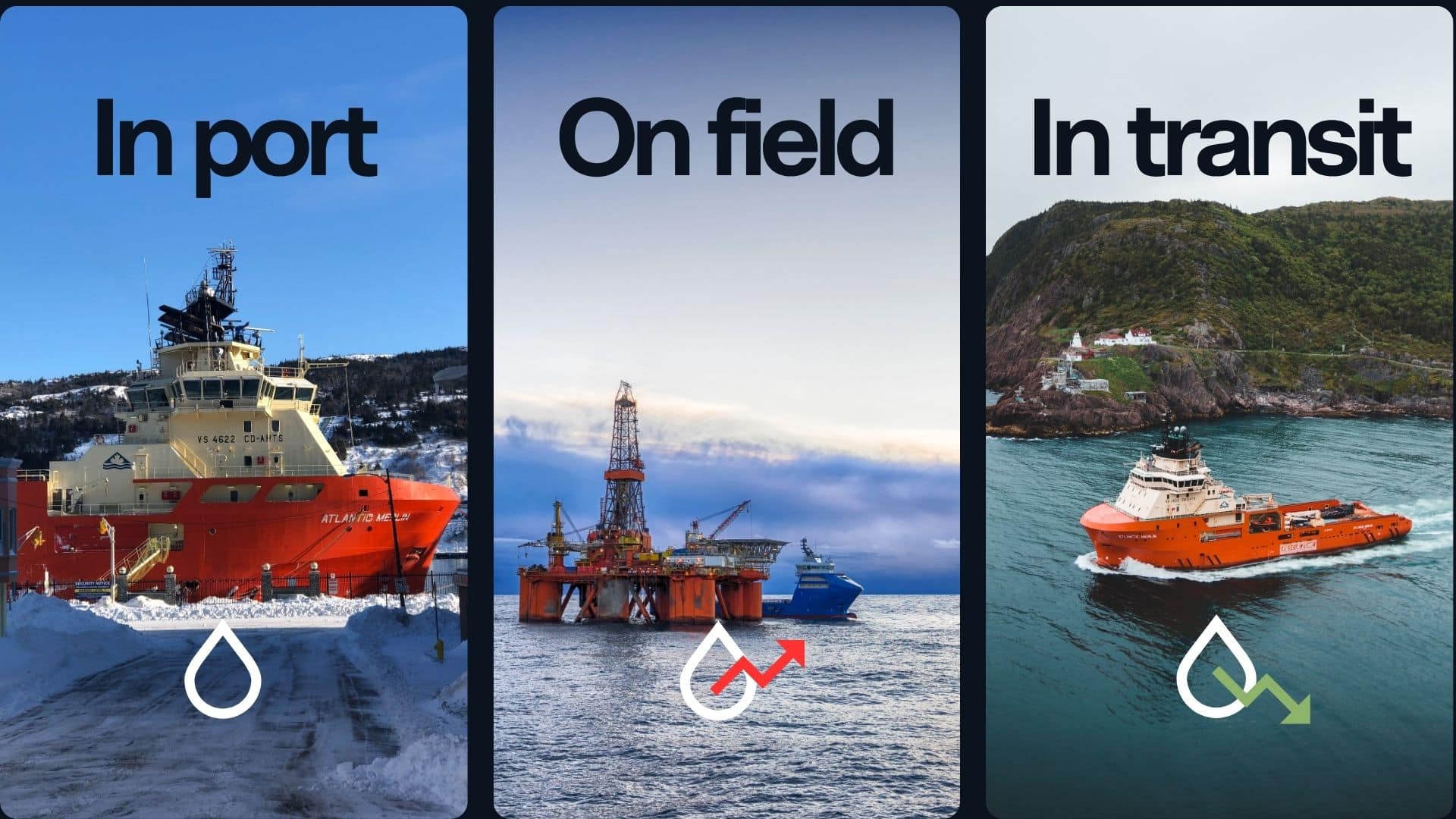
Offshore Supply Vessels (OSVs) can burn from 1 to 8 m³ of fuel per day – yet most operators still rely on a single aggregated number to track it. This blind spot hides inefficiencies, distorts CO₂ reporting, and limits operational decisions.
Structured fuel consumption monitoring is key to closing this gap. In this article, we show how to:
- Structure fuel data for accurate CO₂ tracking
- Identify inefficiencies across operating modes
Why OSV Fuel Data Requires a Different Approach
Tankers and bulk carriers operate on predictable consumption curves, where speed drives fuel burn and emissions. Offshore Supply Vessels (OSVs) operate differently.
Fuel consumption depends on multiple simultaneous demand profiles, such as propulsion, dynamic positioning (DP), and standby operations, each driven by operational constraints from the field or the charterer.
Standby operations often represent the largest source of inefficiency. As an example, with our partnership with ADNOC L&S, one of the world’s largest OSV fleets, we found that some vessels spent up to 80% of their time in standby mode, requiring at least two main engines to run continuously. That fuel burn generated no transport work, produced no cargo movement, and was registered simply as daily consumption. By restructuring standby practices and introducing mooring buoys in shallow-water areas, ADNOC L&S demonstrated immediate gains and adapted to new industry standards.
Learn more: https://opsealog.com/a-step-by-step-approach-to-designing-your-data-reporting-framework/
From Fuel Consumption to CO2: The Calculation
The conversion from fuel to CO₂ is well established. Burning one tonne of MGO produces approximately 3,206 kg of CO₂, based on IMO emission factors. Every tonne of fuel an OSV saves translates directly into more than three tonnes of CO₂ kept out of the atmosphere. (source: ImoEgcsa)
The challenge is having consumption data structured well enough to apply it reliably: classified by fuel type, broken down by consumer, and logged by operating mode. Without that structure, any CO₂ figure produced carries margins of error that grow with fleet size and compound across reporting periods. On a fleet of 20 to 30 vessels, that uncertainty is not acceptable to charterers or verifiers.
Can you trust your data collection tool on fuel consumption?
Three Performance Indicators for Smarter OSV Operations
Fuel data can only support analysis and operational decisions once it’s structured. Here are three indicators, among others, you can consider:
- Fuel Consumption by Operating Mode: Transit, DP, standby, and port idle each carry different engine loads and different emissions profiles. Benchmarking them together produces a number that explains nothing. Operators who separate mode-level consumption consistently find that standby and DP periods, not transit legs, are where the largest inefficiencies sit.
- CO₂ Intensity Per Day On Hire vs Standby: Two vessels with similar total consumption can carry very different emissions profiles depending on the proportion of productive versus waiting time. This indicator gives charterers a transparent view of the environmental cost embedded in a contract. It is also the figure that oil majors are beginning to request in tender documentation.
- Fleet Benchmarking by Vessel Class: According to our latest Global Market Report, CO₂ intensity per operation hour varies significantly across the OSV family: a PSV averages 1.49 tonnes of CO₂ per hour, an AHTS 1.16 tonnes, while vessel types with high idle time reach multiples of those figures. The report identifies that this gap is directly correlated to a vessel’s percentage of idle time and adherence to good practice onboard. An engine running at partial load during unnecessary DP or standby produces disproportionate CO₂ per unit of useful work. Two vessels of the same class on the same field can sit at opposite ends of that range, and only structured monitoring makes that gap visible.
To get a detailed view of the OSV Activity worldwide and get insights into vessel behavior, download our latest Global OSV Market Report.
Fuel Savings and CO₂ Reduction Are the Same Objective
International shipping accounts for approximately 2.89% of global anthropogenic CO₂ emissions, according to IMO’s Fourth GHG Study. OSVs represent a fraction of that total, but with the OSV fleet constituting approximately 6% of the entire maritime fleet, their collective environmental footprint is significant. (Source: ScienceDirect; International Maritime Organization)
These operational levers are already available: BHP, LOA, operational profile, weather, speed, efficiency… Their CO₂ impact is direct and quantifiable. Fuel savings and emissions reduction follow the same path.
A Regulatory Horizon OSV Operators Cannot Ignore
Offshore supply vessels currently sit outside the formal scope of IMO’s CII regulation, which applies to cargo, RoPax, and cruise ships above 5,000 GT. No OSV-specific emissions framework has been established yet.
The direction, though, is clear. At MEPC 83 in April 2025, IMO Member States agreed in principle to the Net-Zero Framework, a set of binding global regulations designed to reduce GHG emissions and achieve the goals of the 2023 IMO strategy. When formally adopted, these measures will be mandatory for large ocean-going ships over 5,000 gross tonnage. Offshore vessels are not the primary target today. They rarely are, until they are. (Source: GreenVoyage2050 — IMO.)
Charterers are already moving ahead of formal regulation. Emissions transparency clauses are appearing in OSV contracts. Scope 3 reporting requirements from oil majors and energy operators are flowing down into vessel selection criteria. Shipowners who can produce structured, mode-level emissions data are already gaining a competitive advantage in contract selection, ahead of any formal regulation.
Charter Party Agreements: Why a Third-Party Solution Matters
Start With the Data You Already Have
The question is not whether your fleet will face emissions scrutiny. It is whether your current fuel reporting will hold up when it does.
Charterers, shipowners… You are already collecting data. The gap is in how your data is structured, classified, and used. Fuel consumption monitoring built around operating modes and CO₂output requires no new sensors, no hardware, no new vessels… It requires the right framework, applied consistently, to make your data work!
What does your current fuel reporting tell you?